Saturday, October 22, 2011

We've had an Outstanding October!

On October 3rd, our class had a field trip to Scorton Creek in Sandwich. Scorton Creek is actually a salt marsh. To get there from our school, it was about a 15 minute bus ride. Once we got there, there were wonderful, informative field guides who helped us along the way. We had to be prepared, because we got very wet and muddy! We had a great time going in the water with nets to get crabs, shrimp, and fish. We used a special type of net called a seine net. Here's what a seine net looks like:


There was a sand bar where we found periwinkle snails. We definitely had to watch our step! If you stepped in the wrong spot, your foot might sink into the muck! Someone in our class even lost a shoe! With some muscle, we were able to yank the shoe out of the muck. Before we left, we were able to get some clay from the salt marsh. Scorton Creek was definitely a lot of fun-- and well worth ruining a pair of shoes! Here are some more pictures from our great trip!


___________________________________________________________________________________

This week, our grade sent in a video to Channel 5, a popular Boston-based news station. Each morning, Channel 5 does something called a "School Shout Out", where they feature a video of students saying "Good Morning, EyeOpener!" Schools have been featured from all around the state. We filmed a video about our Falcon Five, the five characteristics we strive to meet each day. We sent in the video, and they selected us! The Quashnet School 6th graders appeared on their broadcast on Tuesday morning. It was very exciting!


___________________________________________________________________________________


This week in math, we learned about lattice multiplication. The first step you take in lattice multiplication is to make the square, or the lattice. The next step is to put the numbers above and next to the square. Then you multiply the numbers that intersect in each box.After you multiply the two numbers for each box, you add up the numbers along the diagonals. If only one of your factors has a decimal, drop it straight down into your answer. If both of your factors have decimals, you follow the lines the decimals are on towards the center of the lattice until they meet up. Wherever they meet up, carry the decimal down that intersecting diagonal and in to your answer. Give lattice multiplication a try!
___________________________________________________________________________________

This week, Miss Smith's smarties learned all about how to estimate in math. We also learned why estimating is important. Estimating is easy, and it can help you better understand your math problem! All you have to do round each number to a number close to it that you are comfortable with.

For example, if you wanted to multiply 397 x 9, you could round 397 to 400, and you could round 9 to 10. These numbers, 400 and 10, are easier for our brains to work with than 397 and 9. So, you could estimate your answer is with 400 x 10, which equals 4,000. This doesn't give us an exact answer to our problem, but it gives us an "about" answer. The answer to our original problem, 397 x 9 should be close to 4,000.  In fact, 397 x 9 = 3,573. Estimating gave us a good idea as to what our answer would be close to.

Estimating before you complete a problem is a great way to check your work. If you calculated 397 x 9 and came to an answer of 100, you would know that something went wrong with your calculations, because your answer is no where close to your estimate. Give estimating a try!

___________________________________________________________________________________

In E.L.A., we have been writing about a "monster" that we created. We all folded a piece of paper into fourths. Then, we drew the head on the top section of our paper. When we were finished, we folded that over, passed our paper to our neighbor, who then drew the shoulders and chest section of our monster. When they finished, they folded that and passed it to their neighbor, who drew the torso portion of our monster. Finally, the next person drew the legs and feet of our monster.

Our monsters sure are interesting, because as each person was drawing a new section, they could not see the parts that had already been drawn. When all of the parts were finished, our monsters were returned to us so we could see what they look like.
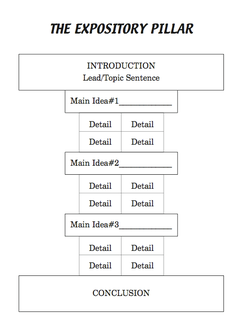


Our assignment has been to color in our monsters and write an expository writing piece about their history, physical features, behaviors, and habitat. We are using The Expository Pillar to organize our writing. This project helps us use our creativity and imagination! Beware... you might run in to one of our monsters, so make sure you read our reports to learn all about them!


___________________________________________________________________________________

On October 31st, we will be in school for part of Halloween! Instead of wearing our costumes to school, we get to have a pajama day! It is also a half day, so school ends at 11:30am. After school, we will be getting together with our friends and getting some treats for ourselves! Happy Halloween!
Saturday, October 1, 2011

The Class of 2012's First Post!

Here's our first post on our blog! We wrote this post as a class on Friday, September 30th. We had groups of students focus on topics we wanted to share. Each group then wrote what they wanted to share about their subject. Here's some of the amazing stuff we did during the first few weeks of school!

It's our principal's birthday and we're planning a flash mob at lunch. A flash mob is when a group of people plans a surprise performance in public. Today in the cafeteria, we're going to trick our principal into giving us her microphone. We are going to sing  and dance to "Happy Birthday" when we get the microphone. It's going to be so funny and nice. Hopefully she will be shocked and never see it coming!

In Mrs. Terrill's Social Studies class we are connecting with students in Rwanda, Africa. We will be Skyping with them and sending them letters. in class, we have made friendship bracelets to mail with the letters. They have recently gotten computers and they love to watch movies on them. So we will also be collecting DVDs to mail to them. We are really excited to make some new friends from another continent!

Something that we're doing in math is practicing making our own multiplication charts from scratch. We get a piece of graph paper, number 1-12 horizontally and vertically, then fill in our facts! Multiplication charts can be used for all sorts of things, like finding equivalent fractions. When we get really good at making these, we will be able to make our own from scratch to use as a reference before any big test! It's super helpful! Sometimes they can be hard, but with practice, multiplication charts can be a breeze. You have to know all of your multiplication facts to make one. To get better and faster at completing multiplication charts, you need to practice, practice, practice! In our class, we have to make a multiplication chart once a week. Every time we make them, we try to make them quicker than we did the time before. You shouldn't be afraid of making a multiplication chart from scratch, as long as you practice! Stay tuned to our blog as we'll share more test-taking and multiplication chart strategies!

This week in math, we also learned how to do some really cool mental math tricks. For example, did you know that you can easily multiply and divide by 10, 100, or 1,000? If you wanted to figure out $5.00 x 10, all you have to do is move the decimal in $5.00 one place to the right. So the answer to $5.00 x 10 is $50.00. The decimal is moving to the right because the number is getting bigger (we're multiplying), and it's moving once because of the one zero in 10. If we wanted to calculate $5.00/10, all we would do is move the decimal point one place to the left. The decimal is moving to the left because the number is getting smaller (we're dividing), and it's moving once because of the one zero in 10. So the answer to $5.00/10 is $.50. The same pattern works for 100-- the decimal would move twice-- and 1,000- but the decimal would move three times. Who needs calculators when our brains can do such amazing mental math?

Another great tip we learned in math this week is how to divide without a remainder. Why is dividing without a remainder important and cool? If you divide without a remainder, you can get an exact number. You can keep dividing, get a more exact answer, and it's not that hard! Imagine you wanted to figure out how many pizzas to buy for 25 people. You want each person to have a slice and each pizza has eight slices. So, if we divide 25 by 8, we can find out how many pizzas we will need. However, we know that 25 does not go in to 8 evenly. Let's look at the picture below to show our traditional strategy:

Normally, this is where we would stop. Now, we challenge you to call your local pizza shop and order "3 with a remainder of 1" pizzas. 3 R1 has no real numerical value!
Now, check out the strategy we learned this week:

 
So again, this is normally where we would stop, because there is nothing left to bring down!

However, we can add a decimal to our dividend (25) without changing its value. We must also remember to carry that decimal up into our answer. Imagine it's a balloon, floating straight up-- and through-- the ceiling!


Now, we can add zeros to the decimal places of 25. 25 is the same as 25.0, or 25.000, or even 25.000000! We can add as many zeros as we need without changing the value of our dividend! Now, we have something to bring down! We can continue to divide!


We can add as many zeros as we need to keep dividing. In this case, we only need to add three before we get no remainder. Sometimes, you will see a repeating decimal occurring in your answer. If this is the case, once you recognize a repeating pattern, you can stop dividing and draw a line over the repeating numbers in the decimal. 


Now, with this number, we can see that we need a little more than three pizzas.  3.125 has much more meaning than 3 remainder one! This means we need three pizzas, and one-tenth of another pizza. We should order 4 pizzas to be safe. Try using this helpful technique next time you divide!

Today, in Science class, we're working on an experiment with Orbeez! Orbeez are a really fun toy. They are small , squishy balls of gel that absorb lots of liquid and grow when they're put in water. We put Orbeez in salt, vinegar, baking soda, and more. On Monday, we will see how they've changed and grown based on what we put them in. It will be fun!


On Monday, our class is going to Scorton Creek. Five nature guides are going with us to teach us about the salt marsh. We will be learning about the plants and animals that live there. We will hopefully see a lot of animals like fish and gulls. We're going to have a great time!

Here is a picture from Miss Smith's field trip to Scorton Creek last year. Isn't it beautiful?


As you can see, we've had a really exciting first few weeks of school. We hope you've enjoyed reading our first blog post. Follow our posts to learn more about our fabulous adventures in 6th grade!

Miss Smith's Facebook Wall